
In this article, we explore the concept of chroma keying, one of the essential pillars of the visual effects industry and modern cinema.
You’ve probably found yourself curious about how chroma key colors work, or what materials are used for green and blue screens. If so, this piece is for you.
Chroma keying, often simply called chroma key, is a special post-production technique used to replace backgrounds and composite different elements into a single shot. In practice, it involves filming a subject or object in front of a solid-colored backdrop usually green or blue and then replacing that background with another image or scene during compositing. These two colors are used because they contrast most strongly with human skin tones, making it easier to isolate the subject cleanly.
As mentioned earlier, keying is part of the post-production process the stage in filmmaking and media production that happens after the footage has been shot. Post-production includes editing, color correction, visual effects, and sound design, but perhaps its most critical part is editing (or montage). One of the more challenging aspects of post-production is ensuring the final film meets the technical and broadcast standards of its intended platform whether that’s television, online streaming services, or theatrical release.
Chroma key screens come in a variety of sizes and materials, and are also widely used in photography studios where they’re referred to as backdrops or “fonds”. In both film and photography, these backdrops simplify the process of separating the subject from its background and replacing it with another image. Green screens are the most common choice since the color green contrasts sharply with human skin and is less likely to appear in clothing, making it ideal for background removal.
Chroma key beyond the backdrop:
It’s important to note that chroma key isn’t limited to backgrounds. It’s also used in costume design and prop manipulation. For instance, parts of an actor’s clothing might be covered in green or blue fabric so that they can later be replaced with CGI elements, or removed entirely. Similarly, rigs, seats, or support structures that actors interact with are sometimes covered in chroma key material so they can be digitally replaced with the intended 3D models or erased in post.

Color Codes for Blue Screen and Green Screen
When it comes to creating chroma key backdrops, precise and standardized color information is used to ensure accurate keying results.
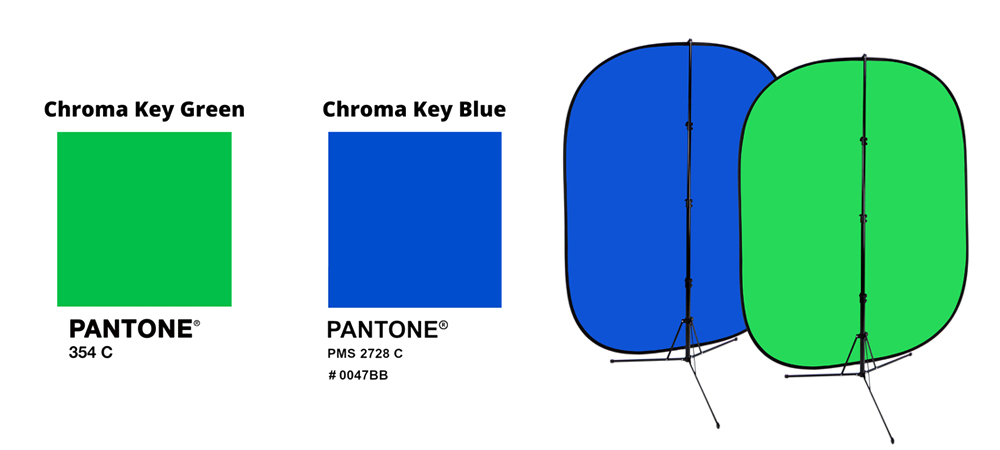
Below are the official color specifications for both green screen and blue screen, including their values across different color systems such as Pantone, RGB, CMYK, Hex, and Web Safe formats.
Chroma Key Green
-
Pantone: 354 C
-
RGB Color Value: 1, 177, 64
-
CMYK Color Value: 81, 0, 92, 0
-
Hex Color Value: #00B140
-
Web Safe Color Value: #009933
Chroma Key Blue
-
Pantone: 2728 C
-
RGB Color Value: 0, 71, 187
-
CMYK Color Value: 90, 68, 0, 0
-
Hex Color Value: #0047BB
-
Web Safe Color Value: #0033CC

Technical Differences Between Green Screen and Blue Screen (and the Advantages of Each)
-
Use of Digital Cameras:
When shooting with digital cameras instead of traditional film, green screens tend to deliver better results. This is because green is a cleaner and brighter color than blue, which helps digital sensors capture it more efficiently. Using a green screen instead of blue also produces less noise during the keying process, resulting in smoother edges and a cleaner composite. -
Color Spill:
Although green or blue backgrounds are removed during the keying and compositing stages, some color spill may remain on the subject especially around edges, hair, or reflective surfaces. This can create an unwanted halo or tint. Depending on your scene, this issue can vary in severity. Blue screens generally produce less spill than green screens, and any color correction needed is typically easier to handle with blue. -
Common Use of Blue Screens:
It’s more common for subjects and objects in a scene to include shades of blue such as blue clothing or props than green. For this reason, choosing a background color that doesn’t appear in your subject’s design is essential for clean keying. That’s also why you won’t see red or yellow screens used; those colors are too common in human skin tones and clothing. -
Lighting Considerations:
Blue screens are less reflective and less bright than green screens, making them better suited for low-light environments. However, this also means they’re more challenging to use in bright or outdoor setups. To achieve a proper key with a blue screen, the camera’s f-stop generally needs to be set higher than when using a green screen. As a result, filming large-scale scenes with blue screens can be more difficult compared to green.
Main Chroma Key Tool | The Backdrop (or “Screen” Fabric)
A backdrop is a fabric (or sometimes paper) used as a photographic background. In studio photography, it allows full control over the background’s color and texture. Depending on the concept or mood of each shot, different backdrops can be hung and swapped easily.
Backdrop Materials:
-
Woven Fabric:
Cotton, canvas, muslin, or other woven textiles are often used. These can be dyed to any color or printed with patterns, making them versatile and affordable options. -
Velvet:
True velvet or “velvet-like” materials that imitate its soft, light-absorbing surface. The imitation type is usually a plastic-coated base sprinkled with fine fibers that adhere with a thin layer of glue. However, these fibers wear off over time with use or contact, causing the surface to look patchy. -
Paper:
Seamless background paper rolls are a studio favorite due to their smooth, crease-free surface and excellent color consistency. They come in long rolls (typically around 11 meters) so worn or dirty sections underfoot can be trimmed off and replaced with fresh paper. -
Glare-Free Vinyl:
A type of matte plastic designed to avoid bright reflection spots from studio lights and flashes. This material is more durable and professional but also the most expensive.
Backdrop Mounting Methods:
-
Basic Method:
Simply attach the fabric to a wall using nails, thumbtacks, or adhesive hooks. -
Portable System:
Roll the fabric or paper around a plastic or cardboard tube and mount it between two adjustable light stands using a crossbar. This setup is easy to transport and assemble. -
Chain System:
A more advanced version that uses rollers and chains to raise or lower the backdrop smoothly without it unrolling by its own weight. -
Motorized System:
Similar to the chain system but controlled electronically, often with a remote control. Professional studios may install systems that hold up to six backdrops on six separate rollers for quick changes.
Backdrops are typically available in widths ranging from one to three meters, suitable for everything from portrait work to full-body and group photography.
Technical Insights into the Structure of Green and Blue Colors
Green (520–570 nm)
Green is a broad-spectrum color located roughly between 520 and 570 nanometers on the visible light spectrum. It’s one of the three additive primary colors, with red being its complementary color.
The word green is believed to originate from ancient Greek, where the sacred city of Greenita surrounded by lush forests gave its name to this color in English.
People with red-green color blindness can usually distinguish between the two, though they perceive them as different hues. For instance, light green may appear yellowish, while dark green can look brown.
Many minerals, like emeralds, exhibit green tones due to the presence of chromium. In the animal kingdom, species such as frogs, lizards, certain reptiles, amphibians, fish, insects, and birds display green coloration often for camouflage. However, the most widespread natural use of green comes from plants, which appear green because of chlorophyll, the pigment responsible for photosynthesis. This process allows plants to convert light into energy, and many animals use the same hue as camouflage among vegetation.
Blue (440–490 nm)
Blue is another primary color, corresponding to visible light with wavelengths between approximately 440 and 490 nanometers. In digital color models such as RGB and even in web design languages like HTML blue (blue) is a foundational color component.
Within the visible spectrum, blue lies between green and violet. When light with a dominant wavelength around 450–495 nm reaches the eye, it is perceived as blue. Most shades of blue contain subtle mixtures of other hues: turquoise has hints of green, while ultramarine leans toward violet.
The sky appears blue because of Rayleigh scattering, a phenomenon where shorter wavelengths (blue light) scatter more efficiently in the atmosphere. Similarly, the deep sea looks blue for the same reason. The blue color of human eyes is explained by Tyndall scattering, and distant mountains often appear bluish due to aerial perspective, another optical effect.
A Glance at Human Skin Color and Pigmentation
The color of human skin is primarily determined by the presence of melanin, a group of natural pigments found in most living organisms. Human skin tones range from deep black to pale white, often with a pinkish tint caused by underlying blood vessels.
Skin color variation is largely genetic, though evolutionary and environmental factors also play roles. Studies show that the greatest diversity in skin pigmentation occurs in sub-Saharan Africa.
Melanin is not a protein but a complex polymer derived from the amino acid tyrosine. It is synthesized within specialized cells called melanocytes, inside structures known as melanosomes. There are three main types of melanin:
-
Eumelanin: Produces black and brown pigments and is the most common form.
-
Pheomelanin: A red-brown polymer containing cysteine, responsible for red hair and freckles.
-
Neuromelanin: Found in the brain, though its function remains unclear.
The amount and type of melanin determine an individual’s skin and hair color. While the number of melanocytes is similar across human populations, their pigment production activity varies with genetics, hormones, and sun exposure. Loss or inactivity of these cells results in lighter or completely white skin.

Sadjad Jahangiri
![Verified]()